A Rainy Afternoon of Rural Screen Stories
A rainy-afternoon plan for comparing rural screen stories through setting and point of view, so you can spot whose countryside is shown and how.
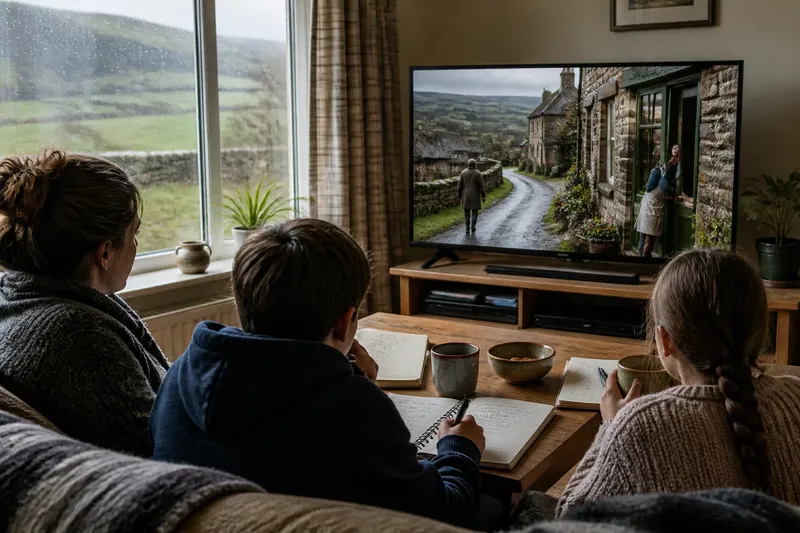
Which countryside does a screen story ask you to see: a place where people live and work, or a distant view arranged for someone passing through? A rainy afternoon with rural screen stories offers time to compare those choices, using place and point of view as a thread rather than treating every green landscape as interchangeable.
You need a screen, a way to note brief observations, and a small selection of contrasting stories. These might be a short documentary, a drama scene, a local video and a nature programme. The point is not to rank them, but to notice what each makes visible, what stays outside the frame and whose experience guides the viewer.
Choose contrasting stories
Pick material with different purposes, not merely different scenery. A short film about a farm, a television drama set in a village and a local walking video may all show lanes and fields, yet use them to tell quite different stories. If you are watching with others, invite each person to suggest one item.
Keep the selection manageable: a few short pieces or chosen scenes leave time for conversation. You could use a public broadcaster’s on-demand service, a library’s film collection, a community group’s online video or a programme already available in the household. Check that each choice actually shows rural life, rather than relying on a title or thumbnail.
Before watching, write down the places you expect to see and why. This gives you something to compare with the screen, without turning the session into a quiz. A village, upland farm, coastal settlement or market town each carries its own details; the film’s setting may be specific, composite or deliberately vague.
Read the place on screen
Start with what the camera gives you: buildings, roads, fields, weather, signs, boundaries and distances. Then ask how those details connect. A close view of a gate can make access feel personal; a wide view of hills can make a settlement seem isolated, even when the story has not explained how people travel or meet.
Notice what is absent as well as present. A village scene might include a pub and church but no bus stop, workshop, school run or newer housing. That omission does not automatically make the portrayal false; it does show which parts of the place the story considers relevant.
Sound adds another layer. Listen for traffic, machinery, birds, wind, voices and silence. Is the sound part of the characters’ everyday surroundings, or does it mainly tell the audience to feel calm, tense or remote? A rural setting becomes more convincing when ordinary sounds have a clear relation to what is happening.
Follow the point of view
Ask whose attention organises each scene. Does the viewer learn the place through a resident’s routine, a visitor’s arrival, a presenter’s explanation or an unseen camera that simply observes? Point of view is not only about who speaks; it also comes through where the camera waits, what it follows and which details receive close attention.
Watch for who gets to describe the countryside. A local character may explain a change in the village, while a visiting narrator may supply the interpretation instead. Neither approach is automatically better, but they give the audience different kinds of knowledge. Notice whether people are shown making decisions and having disagreements, or mainly serving as guides to a picturesque backdrop.
Imagine you choose a short drama scene in which a visitor walks along a lane while a local resident opens a shop. If the camera stays with the visitor’s view of the fields, you might note that the setting is presented as an escape; if it follows the resident’s preparations and conversations, the same lane becomes part of a working day. The difference lies less in the landscape than in whose activity shapes the scene.
Compare stories fairly
Use the same few questions for each selection, then let the answers differ. This prevents a polished drama from being judged by the same standards as a personal phone video, while keeping the comparison focused. Record a phrase or a visible detail rather than trying to summarise the whole piece.
- What exact place does the story suggest, and what clues support that impression?
- Whose eyes or voice guide the audience through it?
- Which everyday activities appear, and which are missing?
- What mood do framing, sound and pace create?
- Does the place affect what happens, or could the story unfold almost anywhere?
These prompts help separate a setting’s appearance from its role in the story. A field might be a workplace, a boundary, a memory or simply a striking view. Two stories can show the same kind of landscape yet ask viewers to understand it in opposite ways.
What does the setting do?
How can I tell whether a rural setting is specific?
Look for connected details rather than a single recognisable landmark: road signs, building styles, local speech, working patterns and the way people move between places. A story can be specific without naming its location, but scenery alone may leave the setting generic.
Does a beautiful landscape make a story inaccurate?
No; visual beauty is a choice, not proof of distortion. Ask whether the framing also gives space to ordinary routines, local knowledge and the practical conditions that shape the characters’ lives.
What if the story gives no local voices?
Note what the audience is asked to infer from images, narration or music instead. Then consider whose account could add context, without assuming that any one resident speaks for an entire community.
How should I compare fiction with documentary?
Compare their choices of place and viewpoint, while recognising their different aims. Fiction can use a setting to build mood or conflict; documentary may explain real people and circumstances, but it still selects what to show.
Keep the conversation grounded
After each item, give everyone a moment to name one detail before discussing interpretations. “The bus stop appeared in the background” is easier to build on than “They got rural life wrong”. Ask what the detail suggests, and whether another scene changes that reading.
If viewers disagree, return to what is visible or audible. One person may read a quiet lane as peaceful, another as cut off; the story’s sound, traffic and characters’ actions can help explain why both readings arose. The aim is to understand how the portrayal works, not to settle a single correct response.
For a simple record, keep a page with the title of each story and three notes: a place detail, a point-of-view detail and one question it left open. This makes the session easy to revisit without turning it into a formal review. If a scene raises a claim about a real place, mark it as something to check rather than repeating it as fact.
Carry one question forward
End by choosing the detail that most changed your impression of the countryside on screen. It might be a voice, a missing service, a sound beyond the frame or an ordinary task that made a familiar landscape feel inhabited. Keeping one question in mind is more useful than deciding whether a story was simply authentic or not.
A rainy-afternoon comparison of rural screen stories works best when the place remains more than scenery and the viewpoint remains open to scrutiny. Next time a countryside scene appears, ask whose day the camera has joined—and whose day it has left just beyond the frame.